

Working Note №06: Everything Got Faster and Nothing Arrived
You might want to check your investment math when implementing AI in your clinical R&D operations.
In the life science and healthcare world, many consultants advise clients to “pluck the low-hanging AI fruit”, which is to use AI for drafting and to speed the paperwork engine.
In April 2026 one firm published six recommended investments for drug development. First on the list was AI document writing, rolled out across everything a company has in development. That program, the firm estimated, could cut development costs by as much as 60 percent and trial timelines by as much as 40 percent. Document review would drop from 14 weeks to 2. Designing the trial itself would get a quarter faster, or better.
Further down the same page, the same firm reported two other figures. Seventy percent of trials are delayed getting started and fewer than 20 percent sign up the number of patients they planned for.
Both sets of numbers are probably accurate, but together they are the problem.
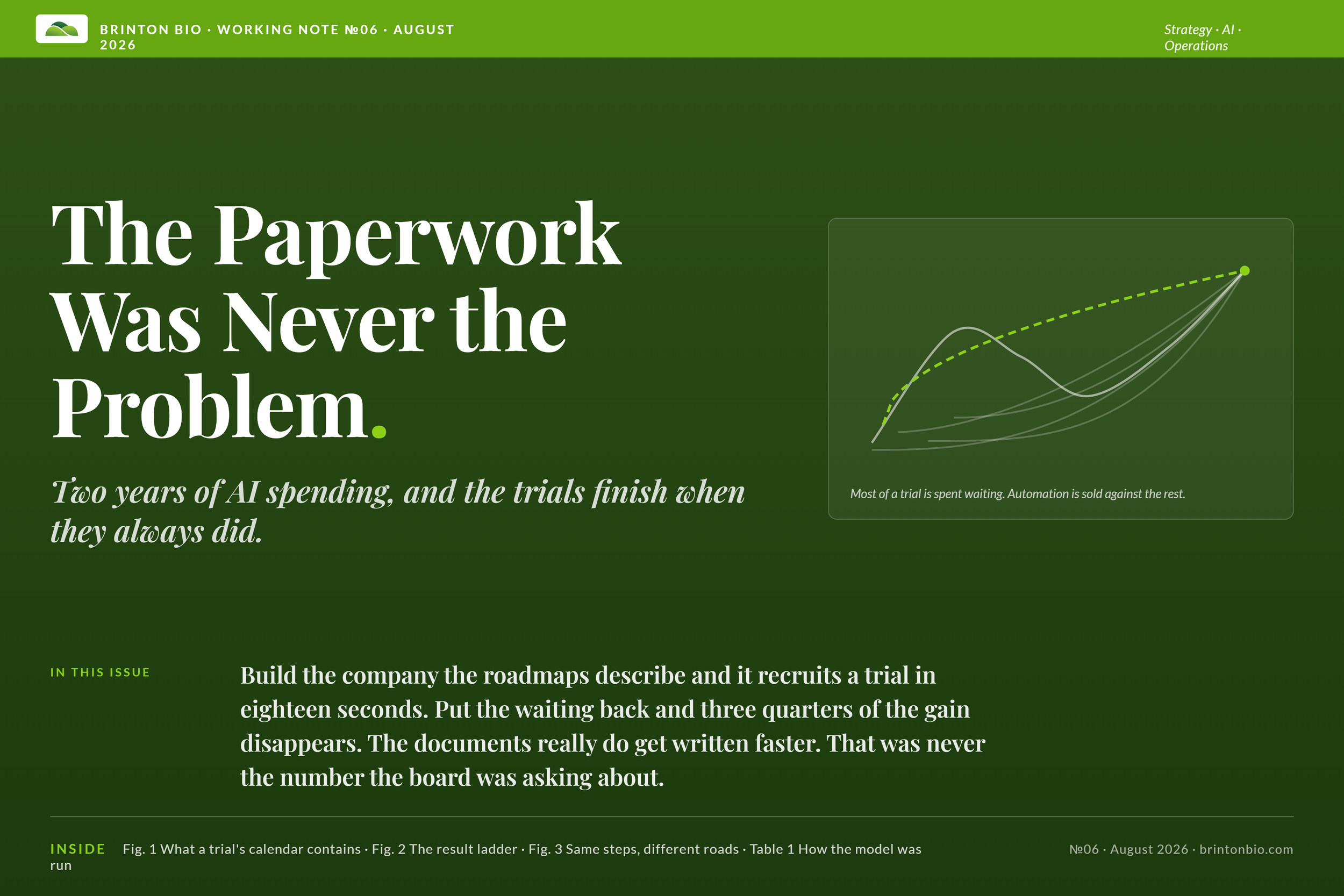
The first set counts hours a company’s own staff spend writing, checking and signing. Software can buy those hours back. The second set counts time the company spends waiting: months while a hospital negotiates a contract, a year finding people who have the disease and meet the rules for joining, then more months while those people are treated and watched. Waiting is the stubborn part. It does not care how quickly the documents were written.
No company has published what happened to its output after introducing AI to all of it. So Brinton Bio built the company in software instead. Seventy people, 8 roles, 16 steps from first draft to submission, 12 trials arriving a year, six years of operation. Then every step the roadmaps recommend automating was automated. Across this note the model was run 553,200 times: 153,600 to test the order in which steps get automated, 390,000 to test what happens when the waiting is put back, and 9,600 on safety. Each comparison runs the same 200 six-year streams of arriving work through both companies, so nothing differs except the one thing being changed.
The paperwork got much faster, but the company barely finished more trials.
This Working Note is about why.