Working Note №05: Where AI Bends Nature
Read on Brinton Bio’s Substack
May 2026
The AI revolution that rewrote how we write, code, and search has not happened in scientific discovery, and the reasons are structural rather than temporary. Chatbot-class AI works because human language was built to be interpreted; the math of next-token prediction maps cleanly onto the grammar of a sentence. Most scientific substrates were not built that way. Materials, cells, and open-ended chemistry do not have the grammar a transformer is looking for, and scaling the model harder does not put one there.
Where the substrate happens to be language-like (proteins are the cleanest example) AI has produced genuinely transformational results. AlphaFold solved a fifty-year-old problem. RFdiffusion is making binders that work in cryo-EM. OpenCRISPR-1 edits human DNA at the efficiency of the natural enzyme it was designed away from. These are real and they are large.
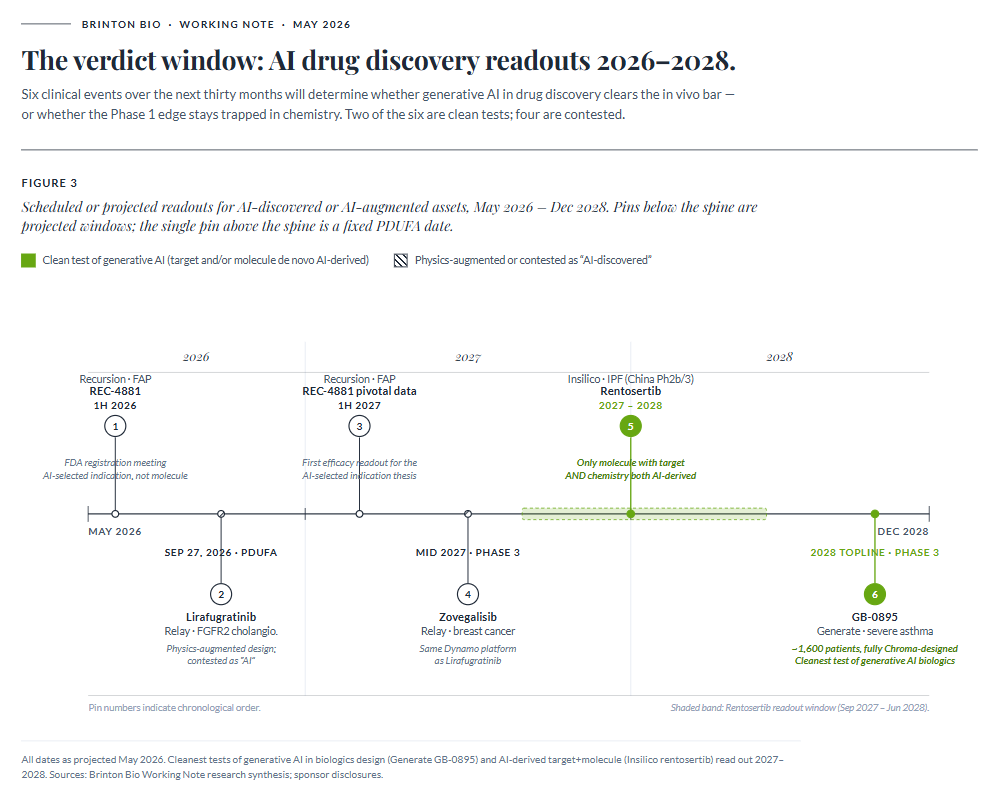
Where the substrate does not match (drug efficacy in human disease, novel materials, autonomous chemistry) the record after seven years and sixty billion dollars is one FDA approval (and that one used physics-based methods that predate the modern AI era), zero approvals from generative deep learning, and a clinical-trial scoreboard statistically indistinguishable from the historical industry baseline.
This article explains why. It argues that AI's success in any scientific domain depends on whether the data substrate is shaped like a language and whether the surrounding architecture respects the physics of that domain. The substrate decides what the architecture can learn. The architecture decides what the data can become. When they match, the field gets AlphaFold. When they do not, it gets a press release.
The framework also says where capital is most likely to compound: physics-grounded architecture against validated targets, paired with the coupled bet on virtual-cell research and organ-on-chip regulatory acceptance. The article closes by naming those allocations directly. The empirical record so far traces the framework almost exactly.
Methodological note: This Working Note was researched using a custom research pipeline (BrintonResearchEngine) and AI-assisted deep research across multiple deep research runs, with all framing, synthesis, and editorial decisions by the author. Citations have been spot-checked but readers should consult primary sources before relying on any specific claim.