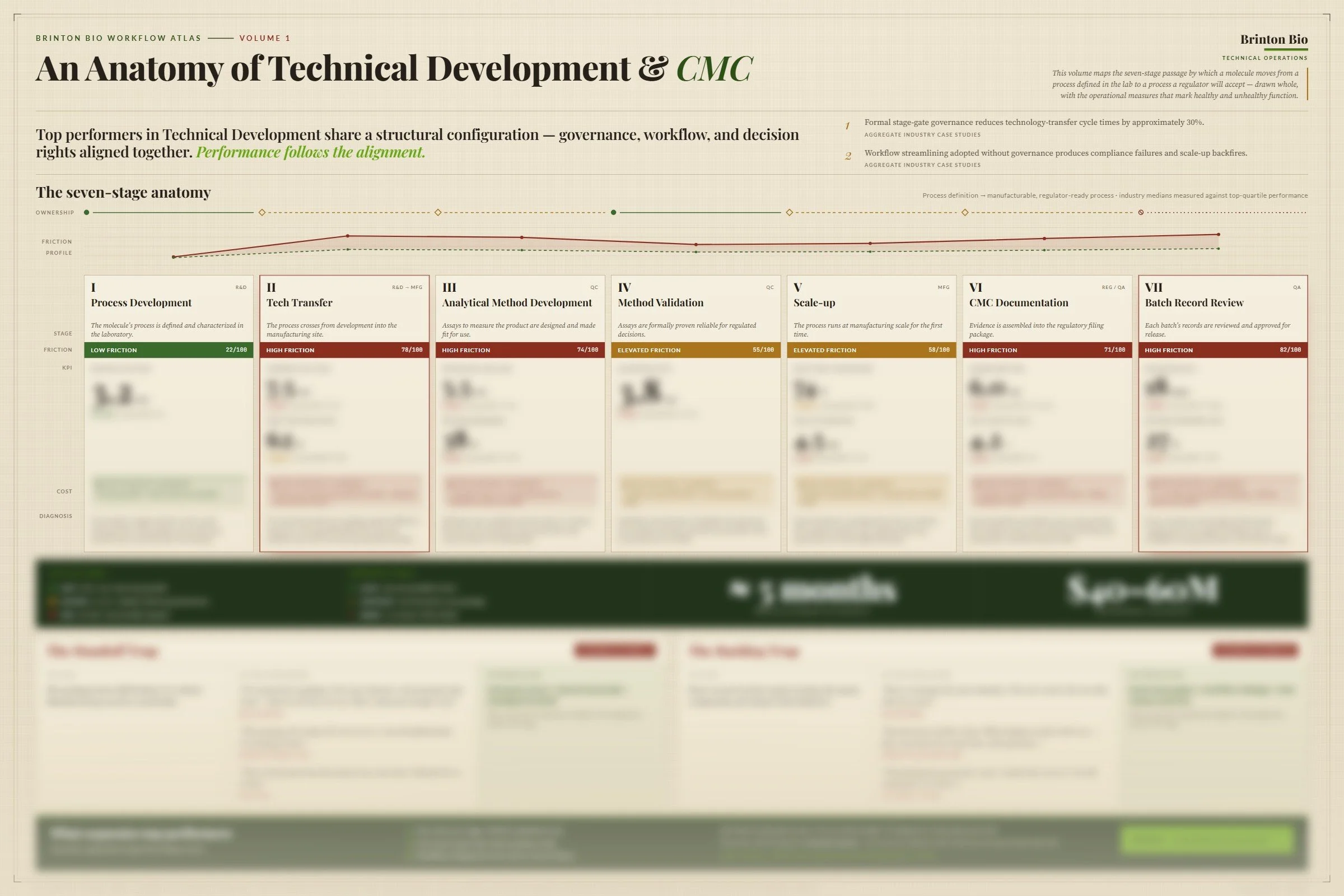
The seven-stage passage that carries a molecule from a process defined in the lab to one a regulator will accept — drawn whole, so you can see where your transfer stands against the top quartile.
It names the measures this function is judged on: tech transfer cycle time, first-time-right
documentation, analytical method development lead time, and CMC dossier preparation time. Industry
median tech transfer runs 7.5 months against a top quartile of four to five — one figure among many, with the median and top-quartile benchmark printed for every stage. Each stage also carries a friction score, a cost-of-delay translation, and a structural diagnosis of why the gap holds.
One landscape diagnostic — a 36 × 24 in high-resolution PDF, built from aggregate industry data
across real technical development and CMC programs.
Grid preview:
Industry median tech transfer: 7.5 months. Top quartile: 4–5.
The seven-stage TechDev & CMC anatomy — every stage benchmarked, median against top quartile.
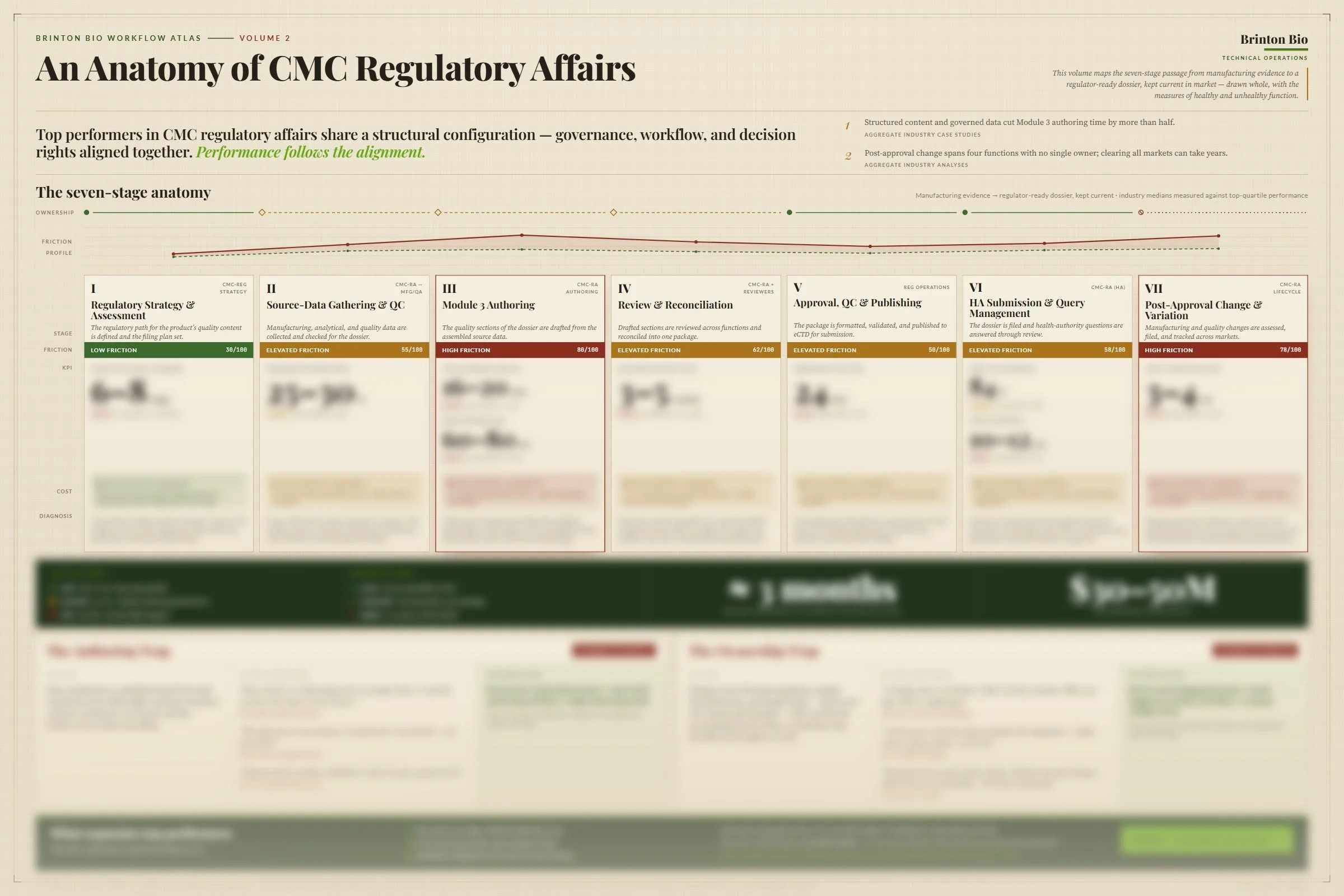
The seven-stage passage from manufacturing evidence to a regulator-ready dossier, kept current in market; drawn whole, so you can see where your submission cycle stands against the top quartile.
It names the measures this function is judged on: submission cycle time, Module 3 authoring time,
first-cycle approval rate, and post-approval variation filing time. Industry median submission cycle
time runs 24 weeks against a top quartile under eight — one figure among many, with the median and top-quartile benchmark printed for every stage. Each stage also carries a friction score, a
cost-of-delay translation, and a structural diagnosis of why the gap holds.
One landscape diagnostic: a 36 × 24 in high-resolution PDF, built from aggregate industry data
across real CMC regulatory affairs programs.
Grid preview:
Industry median submission cycle: 24 weeks. Top quartile: under 8.
The seven-stage CMC regulatory anatomy — every stage benchmarked, median against top quartile.
Need more than the benchmark? See how Brinton Bio helps teams close the gap or contact us.
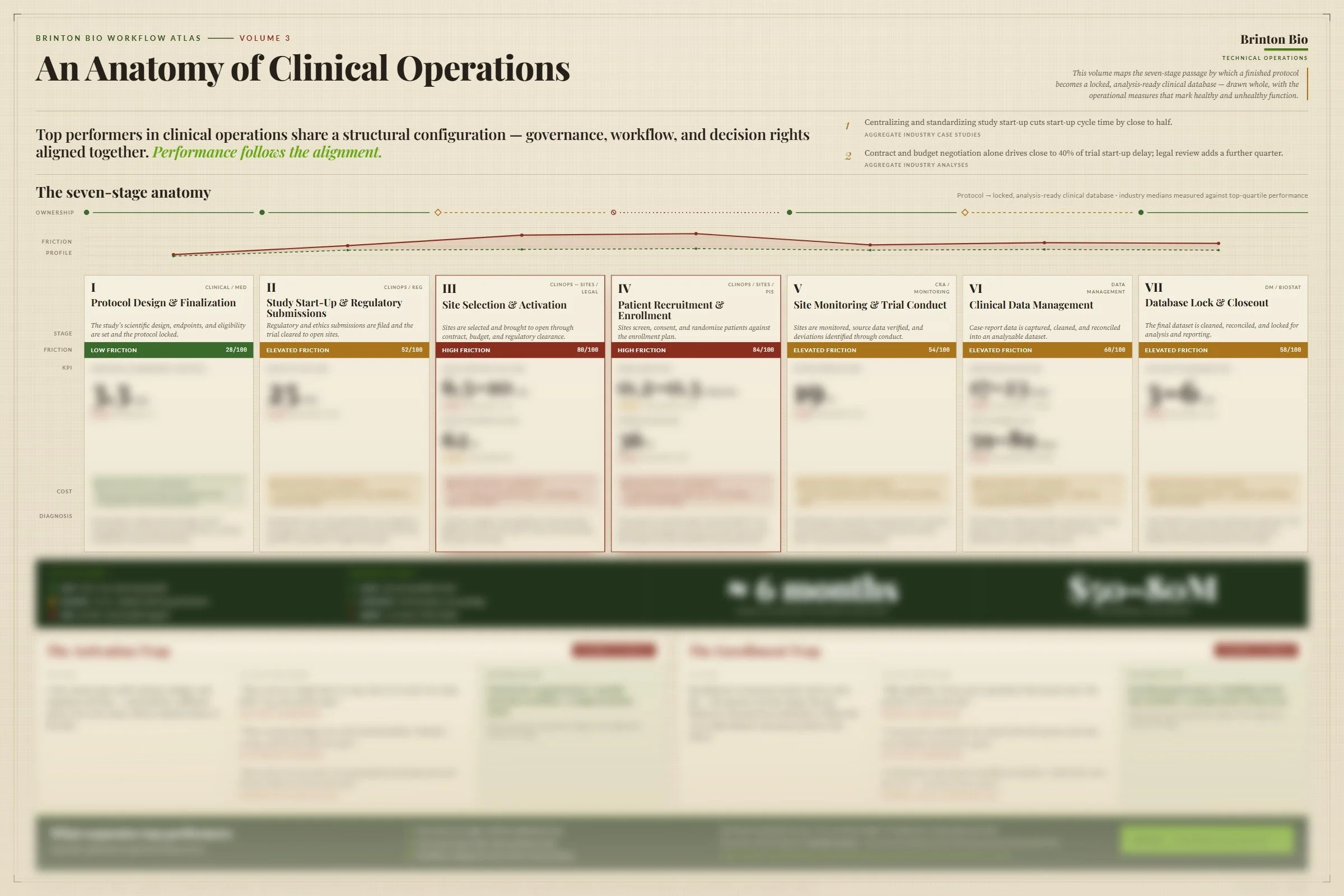
The seven-stage passage by which a finished protocol becomes a locked, analysis-ready clinical
database — one study, start-up through database lock, drawn whole so you can see where your cycle times stand against the top quartile.
It names the measures this function is judged on: study start-up cycle time, site activation cycle
time, patient enrollment rate, and time to database lock. Industry median site activation runs six to
ten months against a top quartile near three — one figure among many, with the median and
top-quartile benchmark printed for every stage. Each stage also carries a friction score, a
cost-of-delay translation, and a structural diagnosis of why the gap holds.
One landscape diagnostic — a 36 × 24 in high-resolution PDF, built from aggregate industry data
across real clinical operations programs.
Grid preview:
Industry median site activation: 6.5–10 months. Top quartile: ~3.
The seven-stage clinical operations anatomy — start-up to database lock, every stage benchmarked.
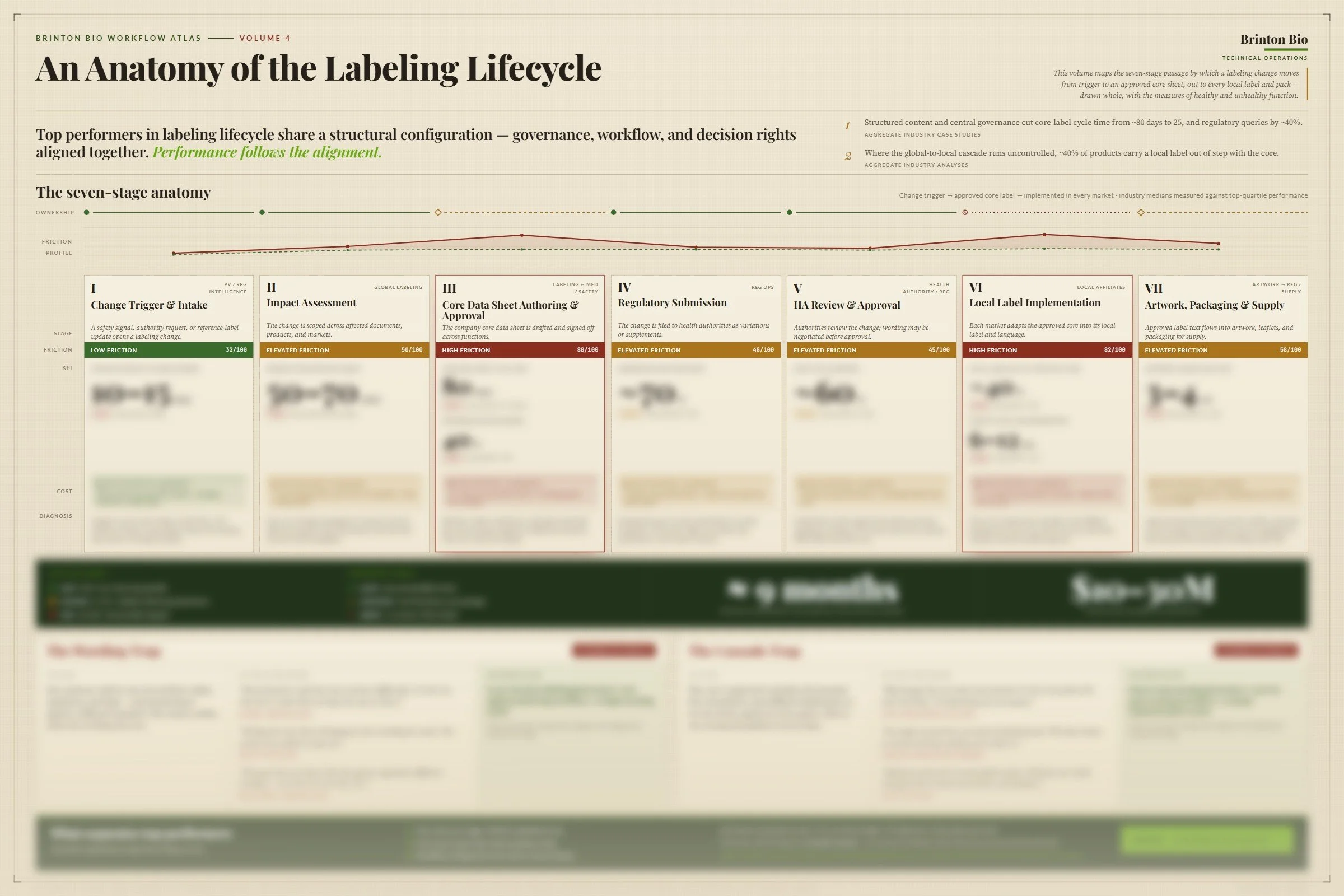
The post-approval labeling lifecycle — one change, from trigger to an approved core data sheet and out to every local label and pack across markets — drawn whole, so you can see where your cascade stands against the top quartile.
It names the measures this function is judged on: core data sheet cycle time, regulatory submission
first-time-right rate, global-to-local implementation time, and artwork change lead time. Industry
median core data sheet cycle runs 80 days against a top quartile of 25 — one figure among many, with the median and top-quartile benchmark printed for every stage. Each stage also carries a friction score, a cost-of-delay translation, and a structural diagnosis of why the gap holds.
One landscape diagnostic — a 36 × 24 in high-resolution PDF, built from aggregate industry data
across real labeling lifecycle programs.
Grid preview:
Industry median core data sheet cycle: 80 days. Top quartile: 25.
The seven-stage labeling lifecycle — trigger to local pack, every stage benchmarked.
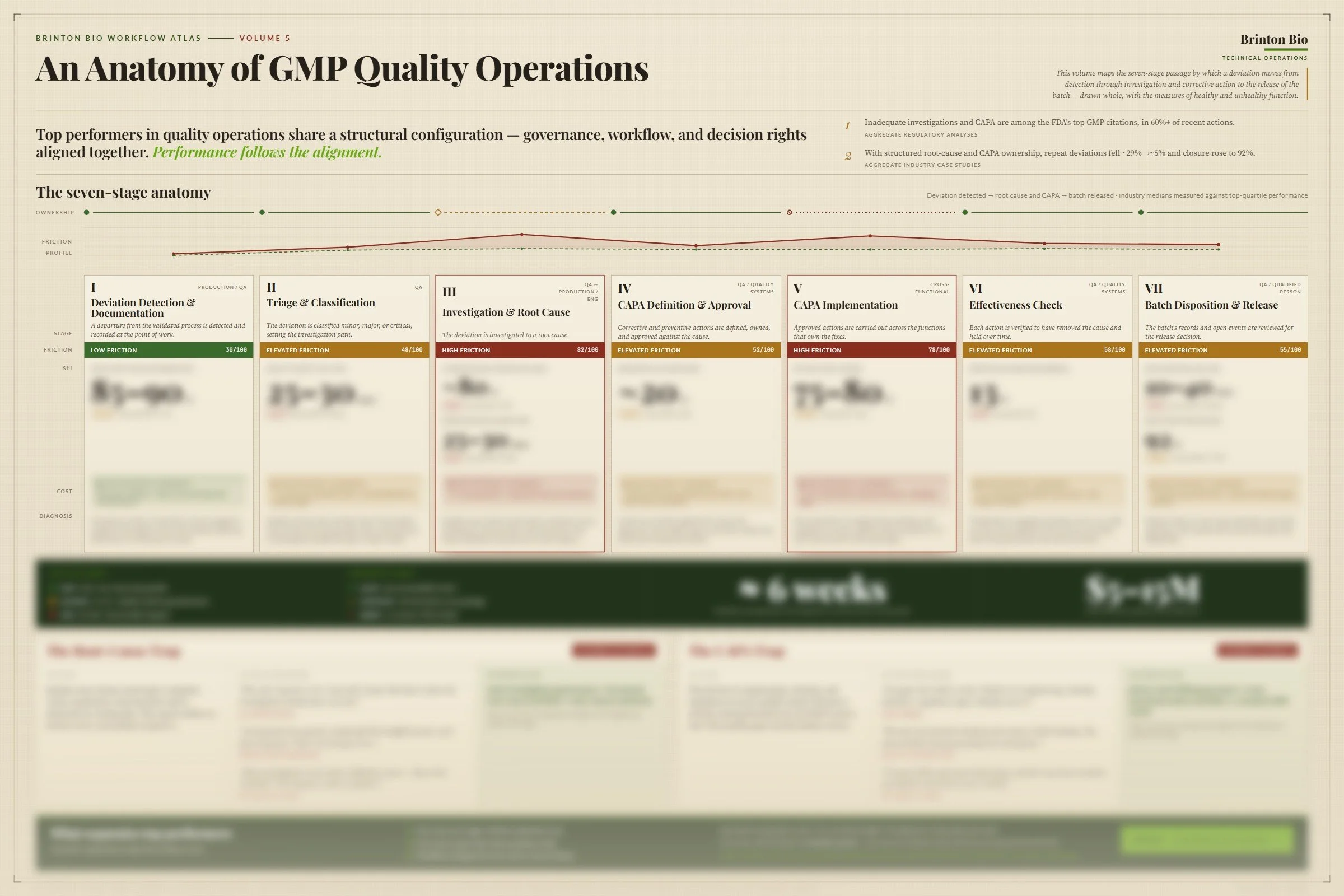
The deviation-to-release quality lifecycle in commercial GMP manufacturing — one event, from
detection through investigation, CAPA, and effectiveness to batch release — drawn whole, so you can see where your closure times stand against the top quartile.
It names the measures this function is judged on: deviation investigation cycle time, on-time CAPA
closure rate, repeat-deviation recurrence rate, and batch release lead time. Industry median
deviation investigation runs 25 to 30 days against a top quartile of 15 — one figure among many, with the median and top-quartile benchmark printed for every stage. Each stage also carries a friction score, a cost-of-delay translation, and a structural diagnosis of why the gap holds.
One landscape diagnostic — a 36 × 24 in high-resolution PDF, built from aggregate industry data
across real GMP quality operations programs.
Grid preview:
Industry median deviation investigation: 25–30 days. Top quartile: under 15.
The seven-stage GMP quality anatomy — deviation to release, every stage benchmarked.
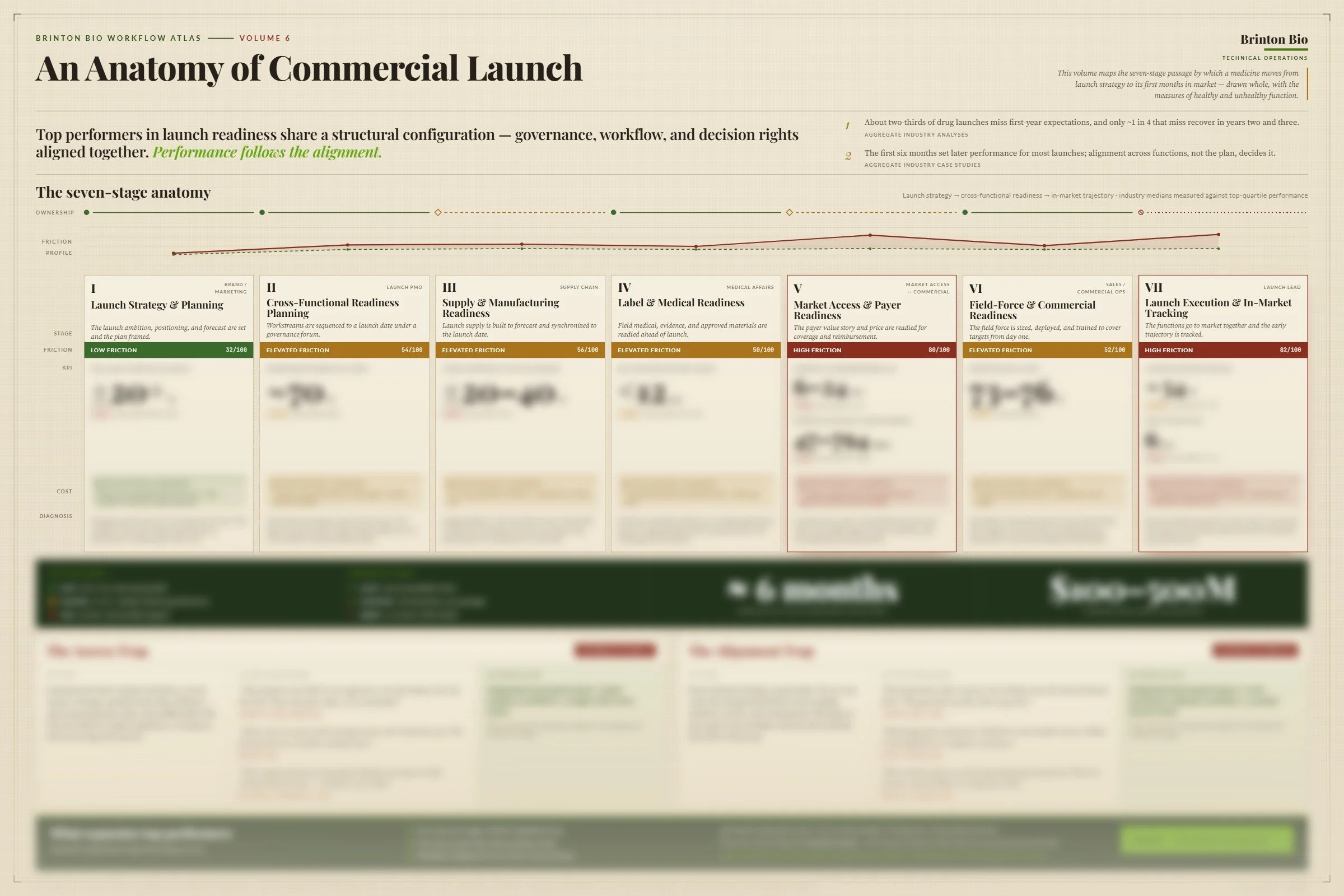
The seven-stage passage by which a medicine moves from launch strategy through supply, medical, access, and field readiness to its first months in market — drawn whole, so you can see where your launch stands against the top quartile.
It names the measures this function is judged on: launch forecast attainment, approval-to-
reimbursement lag, prescription fill rate, and time to peak sales. Across the industry, roughly a
third of launches meet forecast against a top quartile above three in four — one figure among many, with the median and top-quartile benchmark printed for every stage. Each stage also carries a friction score, a cost-of-delay translation, and a structural diagnosis of why the gap holds.
One landscape diagnostic — a 36 × 24 in high-resolution PDF, built from aggregate industry data
across real commercial launch programs.
Grid preview:
Across the industry, ~1 in 3 launches meets forecast. Top quartile: 3 in 4.
The seven-stage commercial launch anatomy — strategy to in-market, every stage benchmarked.
No results match your search. Try removing a few filters.

